.webp)
You have restarted your fitness routine more times than you would like to count. Every single time, the plan was reasonable and the intention was real. And every single time, it quietly dissolved somewhere around week three.
Signing up for an event works because it converts a vague intention into a scheduled commitment with a deadline, a fixed standard, and a cost you have already paid. "Get in shape" has no finish line, so it never competes for your time. A date on the calendar competes the way a work deadline does, and you already know you show up for those.
That is the short version. The longer version is more interesting, and it explains something you have probably noticed about yourself without being able to name it.
Because it is not a goal. It is a mood.
A real goal has three things: a specific outcome, a deadline, and a way to know whether you hit it. "Get in shape" has none of them. There is no moment where a bell rings and someone tells you that you have arrived. So the target keeps moving, and a target that keeps moving cannot be scheduled.
This matters more than it sounds. Your calendar is a competition, and the things that win are the things with dates attached. A client meeting wins. A kid's recital wins. A dentist appointment you do not even want wins, because it has a time on it and a cost for missing it.
An open-ended intention to be healthier loses that competition every week, not because you do not care, but because it never asked for a specific hour.
We wrote a whole piece on this pattern, because it is the single most common thing we see in people who come to Pittsburgh FIT after years of stopping and starting. The restart cycle is almost never a willpower problem. It is a structure problem.
Four things change at once, and they compound.
The deadline becomes real. You now have a fixed number of weeks. Not "eventually." Eleven. That number does something to how you treat a Tuesday.
Your training gets a shape. Instead of wandering into the gym and doing whatever feels right, you have specific things to get better at. Grip. Lunging under fatigue. Holding a pace when your legs are gone. Specificity is what makes progress visible, and visible progress is what keeps people coming back.
You have skin in the game. You paid. Not much, usually, but enough that quietly abandoning it costs you something. Humans are strange about this. We will skip a free thing forever and show up for a thing that cost us twenty five dollars.
You told someone. This is the underrated one. Most people who sign up for an event mention it to a partner, a coworker, or a friend within about a day. Now backing out requires an explanation, and needing an explanation is a surprisingly durable form of accountability.
None of those four is willpower. That is the whole point. They are structural, and structure is a thing you can build on purpose.
Because they solved this problem for millions of people who were not athletes and had no interest in becoming one.
Look at the last fifteen years or so. Tough Mudder and Spartan Race pulled enormous numbers of ordinary adults into training programs they never would have started on their own. The CrossFit Open did the same thing inside gyms, giving regular members a dated, standardized reason to test themselves once a year. Marathon and half-marathon fields have been full of first-timers for decades on the same logic. Now HYROX is doing it, selling out venues faster than anyone predicted.
The events are wildly different. The mechanism is identical. Each one gave people a date, a standard, and a reason to train that was not guilt.
That last part matters. Most fitness marketing runs on shame, and shame is a genuinely terrible fuel. It produces short, intense bursts followed by avoidance. A goal you are moving toward produces something steadier, because you are training for something instead of away from something.
Less than you would think, though some are friendlier than others.
The useful question is not "which event is best." It is "which event will I actually train for." A few things make that more likely.
Pick something with a fixed date rather than a rolling one. Pick something you can practice specifically, where the tasks are known in advance. And pick something far enough out that preparing is possible but close enough that it feels urgent.
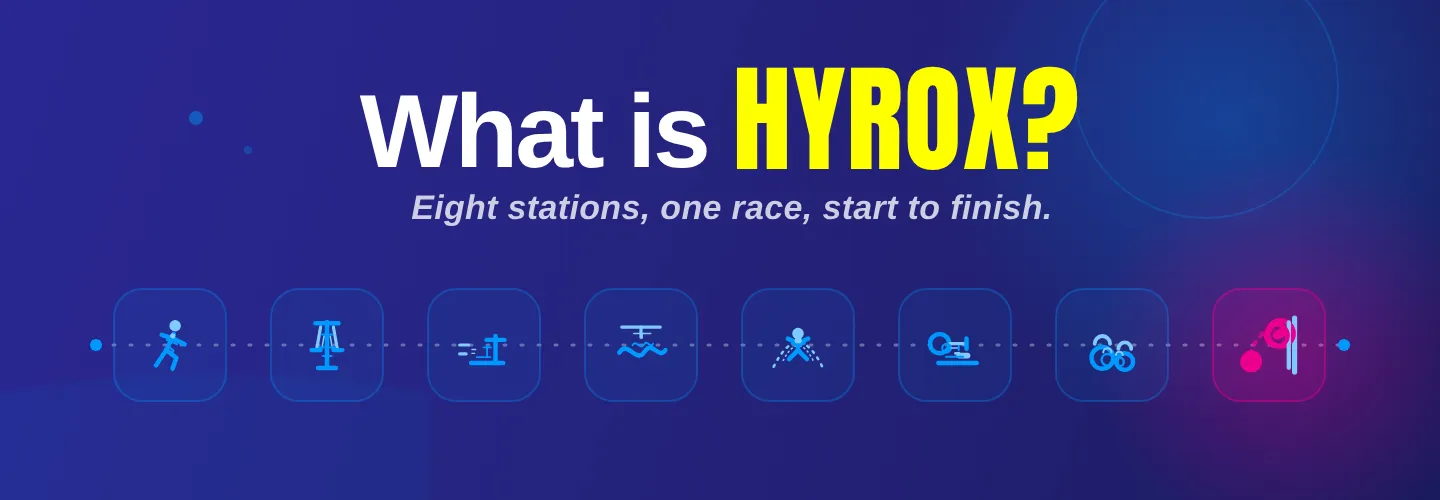
This is part of why HYROX has caught on with people who never thought of themselves as competitors. It is the same eight runs and same eight stations everywhere in the world, which means you can train the exact movements and test yourself against the exact standard. There is no mud pit surprise, no obstacle you have never seen. If you want the full breakdown of the format and every station, we wrote a plain-English guide to it.
But a 5K works. A charity ride works. A benchmark workout you retest in twelve weeks works. Coach Erika trains a member named Joel who invented his own event: every birthday, he does the same number of burpees as the age he is turning. Last year that was 71 of them. That is not a sanctioned race. It works anyway, because it has a date and a standard and he told people about it.
Then you are in excellent company, because almost nobody is ready when they sign up. Being ready is the output of the process, not the entry requirement.
The fear underneath this question is usually not about fitness. It is about being visibly the worst person there. That is a real fear and it deserves a real answer rather than a pep talk, so we wrote about it separately.
The short version: everyone in that room remembers their own first one, and nobody is watching your pace because they are fully occupied with their own.
Far enough that preparing is genuinely possible. For a first HYROX, most guidance lands somewhere in the ten to sixteen week range depending on where you are starting from.
There is a tension here worth naming. Sign up too far out and the urgency evaporates, and you end up doing nothing for two months and panicking for three weeks. Sign up too close and you arrive underprepared, which is not dangerous with good coaching but is less fun than it could be.
If you are new to this, the sweet spot is usually a smaller, friendlier version of the thing a couple of months out, then the real thing after that. Something local, scaled, coached, and low stakes. It gives you a date without the weight of a full race, and it tells you exactly what you need to work on.
Practically, it looks like a lot of people at 210 Thomas St with something specific on their calendar and eight to twelve weeks to get ready for it.
Founder and lead coach Jodi Butler has been saying a version of this for the twelve years Pittsburgh FIT has been open: the event is not the point. The base underneath it is the point. Squat, hinge, carry, push, pull, and enough aerobic capacity to keep going. That base is what carries you up your own front steps at seventy five.
But most people do not build a base for its own sake. They build it because something is coming. The race is the excuse, and the excuse turns out to be load-bearing.
Next in this series: how to train for an event with a partner, which changes the calculation more than most people expect.
Why does signing up for a race make you more likely to work out?
Registering converts an open-ended intention into a scheduled commitment. You get a fixed deadline, a specific standard to train toward, a financial cost for backing out, and social accountability once you tell people. None of those rely on willpower, which is why they hold up on the weeks you do not feel motivated.
Is it bad to sign up for an event when you are out of shape?
No. Almost nobody is prepared on the day they register, and preparation is what the training block is for. The realistic concern is giving yourself enough runway. Most beginners do well with ten to sixteen weeks, or by starting with a shorter scaled version of the event first.
How far in advance should I sign up for a fitness event?
Ten to sixteen weeks is a reasonable window for most first-timers. Much further out and the urgency fades before training begins. Much closer and you arrive underprepared. If you are unsure, pick a smaller local event a couple of months out and treat it as a test.
Do I need to be competitive to enter a fitness race?
No. The large majority of participants in events like HYROX, Spartan Race, and local road races are ordinary adults with jobs and families who are competing against their own previous result. Most events also offer partner or relay formats specifically so people can share the work.
What if I sign up and finish last?
You almost certainly will not, and if you do, nobody around you is tracking it. Everyone in the room remembers their own first event and what it cost them to show up. That shared memory is the actual culture of these events, and it is far more forgiving than the version in your head.


.png)


.png)





.webp)
.webp)
.webp)
.webp)





.webp)

.webp)






.webp)


.webp)
.webp)



.webp)
.webp)
.webp)
.webp)
.webp)
.webp)
.webp)
.webp)
.webp)
.webp)
.webp)
.webp)
.webp)
.webp)
.webp)
.webp)
.webp)
.webp)
.webp)
.webp)
.webp)
.webp)
.webp)
.webp)
%2520(1).webp)
.webp)
.webp)
.webp)
.webp)
.webp)
.webp)
.webp)
.webp)
.webp)


.webp)
.webp)
.webp)
.webp)
.webp)
.webp)

.webp)
.webp)
.webp)
.webp)
.webp)
.webp)