You have done this before. You cut back, you get stricter, the number on the scale moves, and you feel like it worked. Then somewhere in your fifties, the same approach stops paying you back the way it used to. You eat less and you just feel smaller and more tired.
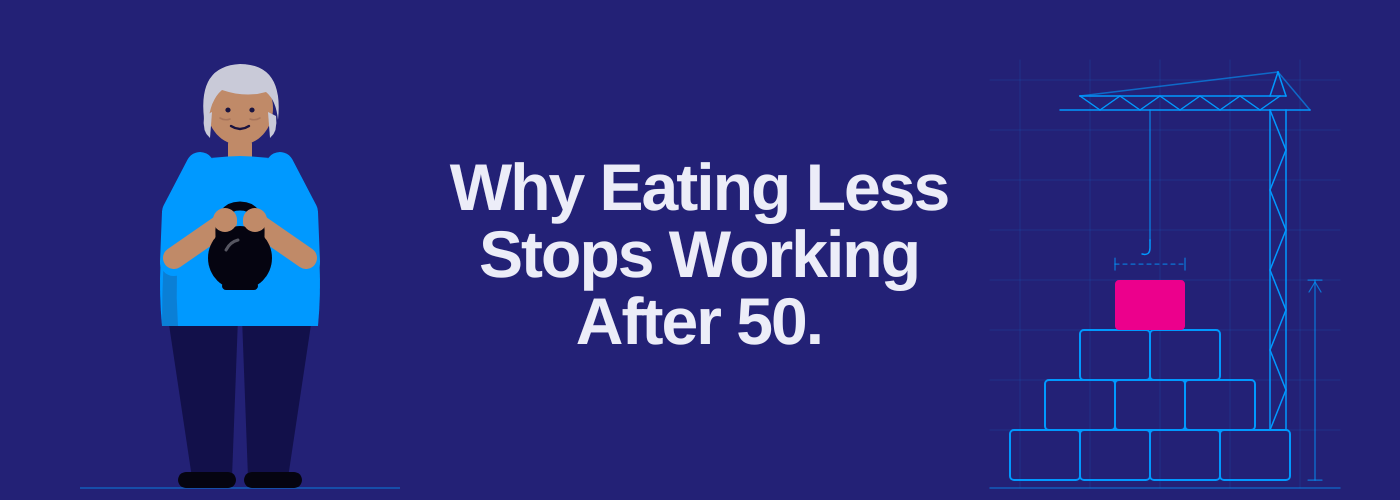
Eating less stops working after 50 because you are no longer trying to lose something. You are trying to build something. Muscle and bone are tissues your body constructs out of raw material, and the main raw material is food, particularly protein. When you restrict hard, your body pulls from the muscle you have instead of building what you need.
That single shift, from losing to building, changes almost every decision that follows.
Rebuilding means adding tissue you do not currently have, rather than returning to a body you used to have. That is a real distinction, not a motivational one. In your thirties, a rough patch meant getting back to baseline. After 50, and especially after menopause, baseline itself has moved. Muscle mass declines gradually from your forties onward, and bone density changes as estrogen drops.
So the goal is not recovery in the old sense. Nobody is bouncing back to 1998. The goal is construction, and construction has requirements.
I keep meeting women who walk in already doing a lot right, says Heather Benek, Director of Nutrition at Pittsburgh FIT. They walk every day, they stay busy, they eat what any reasonable person would call reasonable. And they are still losing ground, because staying active maintains. It does not build.
Because a meaningful calorie deficit tells your body to conserve, and conservation is the opposite of construction. Your body does not distinguish between a deficit you chose and a food shortage. It responds the same way either way.
When protein intake is low and training stimulus is low, the body treats muscle as expendable. It costs energy to maintain, so it goes. This is why so many women finish a restrictive stretch lighter on the scale and weaker in every practical sense, and then feel more fragile than when they started.
Add strength training and enough protein, and the equation changes entirely. Now there is a reason to keep the muscle, and material available to build more of it.
Yes, especially if you are newer to structured strength training. It is not the fastest version of either goal, but it is the version that leaves you with a body that works better.
A Pittsburgh FIT member named Mary is a clear example. She came in at 70, already walking daily and staying active, and after an osteoporosis diagnosis earlier this year she decided to take building strength seriously. She started training with Coach Vee and added nutrition coaching alongside it.
Six months later, she was down ten pounds of body fat with her muscle mass up. Not ten pounds on the scale. Ten pounds of fat, while she added muscle. Her daily habits were not exotic: ninety grams of protein, vegetables at every meal, strength work two to three days a week, and no long gaps.
Her own summary was that she knew she needed guidance, and that having a trainer was crucial. The nutrition side and the training side were doing different jobs, and neither one works alone.
Most women over 50 who are strength training land somewhere between 0.7 and 1 gram of protein per pound of goal body weight, which for a lot of people works out to roughly 90 to 130 grams a day. That is considerably more than most women are eating, and it is the single change that moves the needle fastest.
If that number feels impossible, it usually means protein is concentrated at dinner. Breakfast is the common gap. Twelve grams of protein in a bowl of oatmeal and a coffee is a very normal morning and a very poor start.
Spreading it across the day matters more than perfection. Thirty grams at each meal gets most people to ninety without any heroics.
It looks less like a diet and more like a floor. You are not counting down to a limit, you are making sure you clear a minimum.
A practical day: eggs or Greek yogurt with something substantial at breakfast, a real lunch with a palm-sized portion of protein rather than a salad with three pieces of chicken on it, and a dinner built around protein first with vegetables around it. Snacks exist to close the gap, not to be virtuous.
That is genuinely most of it. The women who rebuild are rarely the ones with the most disciplined plan. They are the ones who stopped treating food as the enemy and started treating it as the supply line.
Bone responds to load and to raw material, the same broad logic as muscle. Strength training puts mechanical stress through the skeleton, and adequate protein, calcium and vitamin D give your body something to work with. That is why salmon, dairy, leafy greens and fortified foods come up constantly in these conversations.
Your specific bone health, including any diagnosis, screening schedule or medication, is a conversation with your doctor, not a blog post. What a gym can do is handle the load and the nutrition consistently, which is not a small share of the work.
Longer than a cut and shorter than you fear. Most people notice energy and daily ease within four to six weeks. Visible and measurable body composition change usually shows up somewhere between three and six months of consistent work.
Mary intended to train for one month. It has been over six, and the thing that kept her going was not the scale. It was going on a canal cruise that required a lot of walking and being ready for it.
This is the most common version of the problem we see in the East End, and it deserves a straight answer: being active and being strong are not the same thing.
Walking is genuinely good for you. It is also not a building stimulus for muscle or bone. If your routine is daily movement plus eating carefully and you are still losing ground, the missing pieces are almost always load and protein, in that order.
Nobody needs to be told to try harder, says Jodi Butler, owner and lead coach at Pittsburgh FIT. The people walking through our door at 210 Thomas St are already trying hard. They need the right thing to try.
If you want the specifics for what changes after menopause and what to do about each piece, that is covered in more depth in our post on what happens to your body after menopause. And if the honest obstacle is what do I cook, start with a single sheet pan.
Why am I gaining weight after 50 even though I eat less?
Muscle loss lowers your resting metabolism, so eating less works against you over time. Chronic restriction also costs you muscle, which lowers metabolism further. Strength training plus adequate protein tends to work better than another round of cutting calories.
How much protein should a woman over 50 eat per day?
Most women over 50 who strength train do well between 0.7 and 1 gram per pound of goal body weight, often 90 to 130 grams daily. Spreading it across three meals, roughly 30 grams each, is easier than concentrating it at dinner.
Can you build muscle after 60 or 70?
Yes. Research consistently shows adults in their sixties, seventies and eighties gain strength and muscle from resistance training. Progress is slower than at 30, but the relative gains in function and daily independence are often larger.
Is walking enough exercise after 50?
Walking supports cardiovascular health, mood and daily movement, and it is worth doing. It does not provide enough load to build muscle or meaningfully stress bone. Most people need resistance training two to three days a week in addition to walking.
Do I have to stop losing fat to build muscle?
Not necessarily. People newer to structured strength training, and people currently under-eating protein, often lose fat and add muscle at the same time. It is slower than focusing on one goal, but the end result is a stronger body.

.png)




.webp)
.webp)
.webp)
.webp)
.webp)





.webp)

.webp)








.webp)


.webp)
.webp)



.webp)
.webp)
.webp)
.webp)
.webp)
.webp)
.webp)
.webp)
.webp)
.webp)
.webp)

.webp)
.webp)
.webp)
.webp)
.webp)
.webp)
.webp)
.webp)
.webp)
.webp)
.webp)
.webp)
.webp)
%2520(1).webp)
.webp)
.webp)
.webp)
.webp)
.webp)
.webp)
.webp)
.webp)
.webp)


.webp)
.webp)
.webp)
.webp)
.webp)
.webp)

.webp)
.webp)
.webp)
.webp)
.webp)
.webp)
.webp)
.webp)
.webp)
.webp)
.webp)
.webp)