Maybe it's a knee that complains on the stairs, or a shoulder you've been warming up a little longer every month. You mention it to your coach, who adjusts your workout. You mention it to your doctor, who suggests physical therapy. And somewhere in between, nobody is quite talking to anybody.
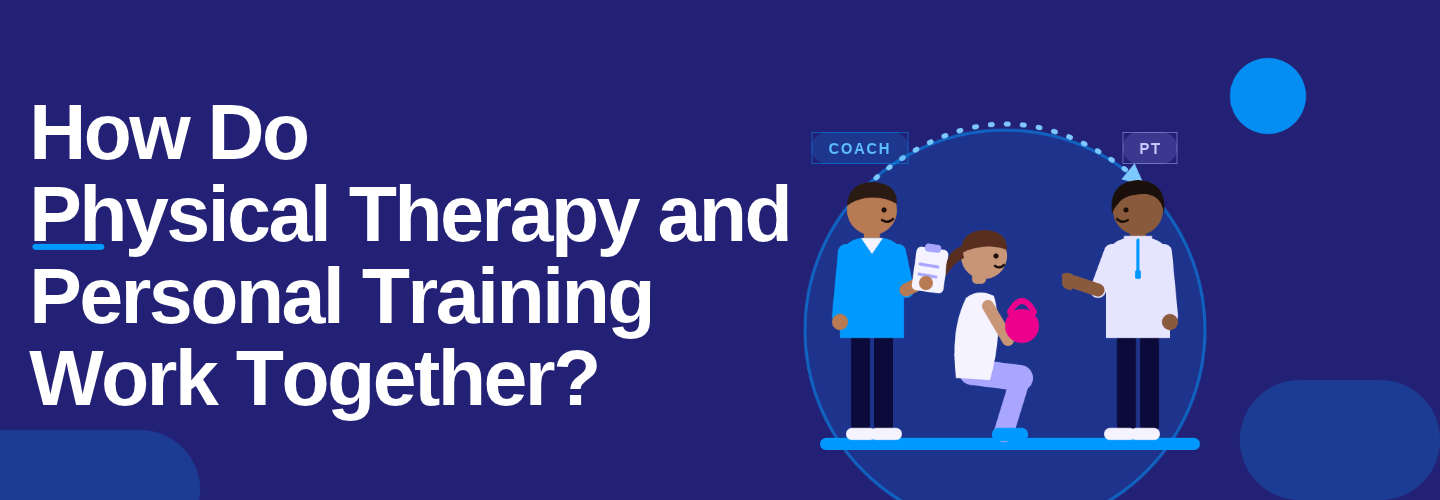
Physical therapy and personal training work best as a team with clear roles. Your physical therapist evaluates and treats the injury, and your coach builds strength and confidence around it, following the PT's guidance. When the two communicate, you keep training while you recover instead of stopping completely and starting over later.
Here's what each one does, why so many people fall into the gap between them, and how it works now that Pittsburgh FIT has a Doctor of Physical Therapy inside our own community.
A physical therapist is a licensed clinician who can evaluate an injury, figure out what's driving it, and treat it. A personal trainer can't diagnose or treat anything, and a good one won't pretend to.
That line matters. When something hurts, the most useful question is usually what is actually going on, and that's a clinical question. A PT can look at how you move, test your strength and range, and use hands-on treatment when it's appropriate. Then they give you a plan built around what they found.
A coach's job starts from that plan. We choose exercises, manage load, coach technique, and progress you over months and years. We walk through that side of the line in more detail in Can a Personal Trainer Help With an Old Injury?
Because the two usually live in different buildings, on different schedules, with people who never meet. You get your PT exercises on a sheet of paper, go back to the gym, and try to translate.
That translation is where things get lost. Your coach doesn't know exactly what your PT is working on. Your PT doesn't know what your training looks like. So you either do too much too soon, or you stop training altogether just to be safe. Neither is what anyone wanted for you.
The other common story is the ache that never gets checked at all. It isn't bad enough to call a doctor, so you just work around it. You skip lunges, avoid anything overhead, and quietly shrink your training to fit the injury. Months later, the workaround has become the plan.
Coach Jodi Butler has watched both stories play out since she opened Pittsburgh FIT in 2013. The fix is rarely more toughness. It's getting the right person to look at the problem early, and making sure that person and your coach are on the same page.
It looks a lot less dramatic than an injury usually feels. Instead of stopping, you adjust. Your PT tells you what to work on and what to avoid for now, and your coach builds your sessions around that so you keep training everything else.
In practice, that might mean your legs keep getting stronger while a cranky shoulder gets a break from pressing. It might mean your PT exercises become your warm-up, so they actually happen instead of living in a drawer. As you progress, the restrictions loosen and your training gradually opens back up.
The biggest difference is momentum. People who keep showing up while they recover tend to come out of an injury feeling capable. People who disappear for three months often come back feeling like they're starting from zero, physically and mentally.
If something is new, getting worse, or has never been evaluated, start with a clinician. If it's been checked out and you've been cleared, coaching is usually the right place to keep building.
Some signs it's time for a professional look include sharp or stabbing pain, swelling, numbness or tingling, pain that wakes you up at night, or an ache that changes how you move. Pain that keeps coming back after weeks of working around it deserves a look too. We cover more red flags in Physical Therapy Is Over. Now What?
When in doubt, ask. A good coach will never be offended that you want a PT's opinion. At Pittsburgh FIT, we'd honestly rather you get one.
Because they speak your language. When you say your back tightens up at the bottom of a squat, a PT who lifts knows exactly what position you mean, and they understand what you're trying to get back to.
That's a big part of why we're so excited about Eric Lehman, DPT, of Movement X Physical Therapy. Eric isn't a vendor we found online. He's a Pittsburgh FIT member who takes classes here and competes in powerlifting. He has spent more than ten years specializing in fitness athletes, from CrossFit and HYROX to powerlifting and Olympic weightlifting, including nearly four years at Cleveland Clinic.
Eric also spends real time on education and adjusting your training while you recover. He says that approach often means far fewer visits than standard PT, which matters when your calendar is already full.
Eric is now Pittsburgh FIT's physical therapy partner. He sees Pittsburgh FIT clients in two places: at our gym at 210 Thomas St in Pittsburgh's East End, or in the comfort of your own home. His standard sessions are 60 minutes, fully one-on-one.
That means the person looking at your knee might be the same person you see at the squat rack on a weekday morning. It also means Eric and our coaching team meet regularly, so we're all speaking the same language about how to keep you training safely.
If you're a member and something has been bothering you, tell your coach. We can help you figure out whether it's a training adjustment or a question for Eric. If you're not a member, you can book with Eric directly. Get to know him in Meet Eric Lehman, DPT: Physical Therapy at Pittsburgh FIT.
Start small. You don't need to commit to a full plan of care to get some clarity. A short session with a physical therapist can tell you a lot about what you're dealing with and what your next step should be.
That's exactly why Eric is hosting 30 for 30 on Saturday, November 21. If you're wondering what that half hour actually looks like, we walk through it in What Happens at a 30-Minute Physical Therapy Session?
30 for 30 with Eric Lehman, DPT
Saturday, November 21, 8:30 to 11 AM at Pittsburgh FIT. Thirty one-on-one minutes on that nagging injury for $30, and every dollar goes to charity. Only five spots, and you don't need to be a member.
PittsburghFIT.com/Go
Can I see a physical therapist and a personal trainer at the same time?
Yes, and for many people it's the best approach. Your physical therapist treats the injury and sets the guardrails, and your coach keeps you training within them. Share your PT's guidance with your coach so your sessions support your recovery instead of working against it.
Should I stop working out if something hurts?
Not necessarily. For many aches, you can keep training the parts of your body that feel fine while you get the painful area evaluated. Stop and see a clinician if the pain is sharp, comes with swelling or numbness, or keeps getting worse over time.
Does Pittsburgh FIT have a physical therapist?
Yes. Eric Lehman, DPT, of Movement X Physical Therapy is Pittsburgh FIT's physical therapy partner. He is a member who trains at the gym and sees Pittsburgh FIT clients one-on-one at 210 Thomas St in Pittsburgh's East End or in their own homes.
Do I have to be a member to see Pittsburgh FIT's physical therapist?
No. Eric Lehman, DPT, works with Pittsburgh FIT members and non-members, and you can book with him directly through Movement X Physical Therapy. Members get the bonus of a PT who already knows the gym, the coaches, and what their training looks like.