
In Part 1 we made the case that moderate cardio has stopped paying you back and that resistance training is where the return is. Fair enough. But "lift heavy" is useless advice without a number.
Women over 40 should lift heavy enough that the last one or two reps of a set feel genuinely difficult, typically in the five to twelve rep range, with one or two reps left in reserve. That usually means loads well above the five and ten pound dumbbells most women are handed. Two to three sessions a week is enough.
Here is what that means in practice, and why the advice you were probably given is outdated.
Because light weight was never the thing producing the result. Your hormones were.
Estrogen is one of your body's strongest signals for holding onto muscle. As it declines through the perimenopause transition, that signal weakens, and women lose roughly 0.6 percent of muscle per year after menopause. Less muscle means a slower metabolism, less strength, and worse energy.
The stimulus has to come from somewhere else, and the only reliable somewhere else is meaningful mechanical load. Three sets of fifteen with a five pound dumbbell does not provide it. Your body reads that as easy, because it is.
There is a second problem stacked on top. Women in this transition also face anabolic resistance, meaning the body becomes less efficient at using both the protein and the training stimulus it gets. You need a clearer signal than you used to, not a gentler one.
Use the reps-in-reserve method. It is more reliable than percentages and you do not need a one-rep max to start.
Pick a weight where you finish your set with one or two reps left in the tank. If you could have done six more, it is too light. If your form breaks down before you finish, it is too heavy.
For most sets, aim for five to twelve reps. Lower reps with heavier weight build strength most efficiently. Slightly higher reps still work well and are a bit more forgiving while you learn the movements.
The number on the dumbbell is not the point. The effort is the point. What tends to surprise people is how quickly the number climbs once they stop guessing. Caitlin McGuirk had never touched a barbell before joining Pittsburgh FIT. Two years of twice-weekly work with Coach Corey later, her deadlift is at 190 pounds and she is going after 200.
No, and this is the myth that has cost women the most.
Significant muscle growth in women requires extraordinary effort, years of specific training, and usually a level of intent and caloric surplus that is nothing like what happens in a normal training program. Dr. Lauren Colenso-Semple, who holds a PhD in integrative physiology, is direct about this: the conditions required are very specific and they do not happen by accident.
What actually happens is that women get denser, stronger, and better defined, and their clothes fit differently. The women lifting heavy at our gym in the East End do not get bulky. They get capable.
Erin A., a pastor in Sharpsburg, put together a run of PRs in a single month: a 200 pound safety bar squat, a 130 pound bench, a 270 pound trap bar deadlift, and a 70 pound strict press. She is now chasing her first pull-up. The moment that mattered to her was not aesthetic at all. It was realizing she could carry her wife if she ever needed to.
Compound movements, which means anything that uses several joints and a lot of muscle at once. These give you the most stimulus per minute, which matters when you have three sessions a week and a full calendar.
Squat. Back squat, front squat, safety bar, goblet. Legs, hips, and core.
Hinge. Deadlift, trap bar deadlift, Romanian deadlift. The whole posterior chain, and the lift that most changes how people feel about their own strength.
Push. Bench press, overhead press, push-ups. Chest, shoulders, triceps.
Pull. Rows, pull-downs, eventually pull-ups. The counterweight to a life spent at a desk.
Carry. Farmer's carries, suitcase carries. Unglamorous and enormously useful for real life.
You do not need much beyond these. Accessory work has its place, but the compound lifts are where the adaptation lives.
Two is a real dose. Three is better. Four is not necessary for most people and often works against recovery when sleep is already compromised.
There is good evidence that training at around 80 percent of effort, even twice a week, is enough stimulus to build bone density in at-risk women. Two sessions is not the minimum viable version of a program. It is a legitimate program.
This matters because the most common failure mode we see is not undertraining. It is someone deciding to go from zero to five days a week, holding it for three weeks, and quitting. Two sessions you actually do beats four you plan.
This is the question that keeps most people lifting light, and it deserves a real answer rather than reassurance.
Heavy lifting with poor technique is a genuine risk. Heavy lifting with good technique is one of the best things you can do for joint health, because stronger muscles and connective tissue mean better support around the joint.
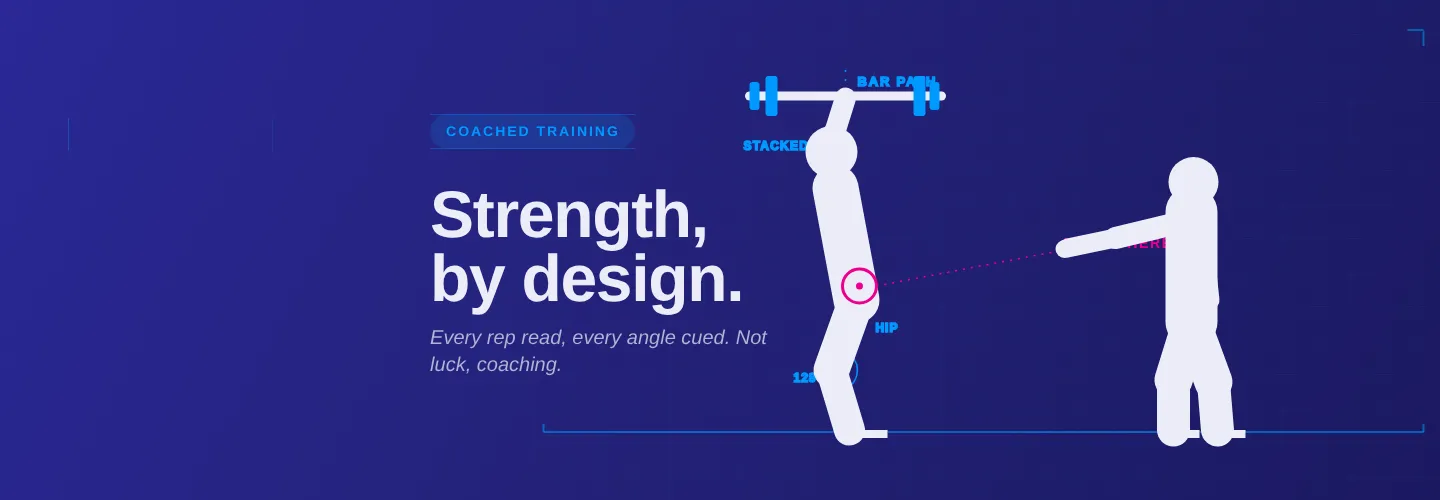
The variable is coaching, not weight. This is where working with someone matters more than anything else in this post. A coach watches the rep you cannot see, catches the pattern before it becomes a problem, and tells you when to add weight and when to hold.
Palma W. came to us at 55 with hip pain. Five weeks in, she had lost 3.7 percent body fat, her hip pain had resolved, and her digestion had improved. She is now preparing to summit Mt. Whitney. Her line about it has stuck with our coaches: mindset is the biggest limiting factor to aging.
If your joints allow it, yes, and it is worth the small hassle.
Bone responds to impact in a way it does not respond to steady load alone. Up to 20 percent of bone density can be lost in the years around menopause, and multidirectional skeletal stress is one of the few things that meaningfully pushes back.
This does not mean box jumps if box jumps scare you. Step-ups, small hops, skipping, or a few pogo jumps before your session all count. Thirty seconds. It is one of the highest-return, lowest-effort things on this list.
Lifting without eating enough protein is like paying for a gym membership and never going. The stimulus is there and the raw material is not.
Most women in this window need roughly 100 to 140 grams a day, in 30 to 40 gram doses, ideally with some before and after training rather than training fasted. Coach Heather Benek covers the full breakdown in our protein guide, linked below.
Pick two days. Do one squat pattern, one hinge, one push, one pull. Three sets of eight, with a weight that makes the last two reps a real decision.
Write down what you used. Next week, add a little. That is the entire program in its simplest form, and it works.
Did you know that we put all of this in one place?
The Peri/Post-Menopause Playbook, Still Strong. Still You., covers the protein numbers, the training approach, the sleep piece, and a two-minute check-in that shows you exactly where your biggest gap is right now. It is built around the questions the women at Pittsburgh FIT had before they walked in our door.
Get the free guide: https://go.pittsburghfit.com/womens-health-and-hiit-opt-in
How heavy should a 45-year-old woman lift?
Heavy enough that the last one or two reps of a set are genuinely difficult, usually in the five to twelve rep range. Age matters far less than training history and technique. A well-coached 55-year-old often lifts heavier than an undertrained 35-year-old within a few months of starting.
How many days a week should women over 40 strength train?
Two to three days a week is the sweet spot. Two sessions is enough to build strength and bone density when the load is meaningful. Adding more days rarely helps and often hurts recovery, especially when sleep is already disrupted by the perimenopause transition.
Is it safe to lift heavy weights during perimenopause?
Yes, and it is one of the most protective things you can do for bone density and muscle mass in this window. The risk lies in technique rather than load. Working with a coach who can see your form and progress you sensibly makes heavy lifting safer than most cardio.
What if I have never lifted weights before?
Then you are in the best possible position, because early progress comes quickly. Start with compound movements at a light load to learn the pattern, then add weight steadily. Many of our members had never touched a barbell before joining and now deadlift well over 150 pounds.
Do I need to lift heavy if I already run?
Yes. Running does not preserve muscle mass or build bone density the way resistance training does, and runners in their forties are often the group losing muscle fastest. Strength training also tends to make running feel better by improving how much load your joints can absorb.

.png)

.webp)
.webp)
.webp)
.webp)
.webp)




.webp)

.webp)







.webp)


.webp)
.webp)


.webp)
.webp)
.webp)
.webp)
.webp)
.webp)
.webp)
.webp)
.webp)
.webp)
.webp)
.webp)
.webp)
.webp)
.webp)
.webp)
.webp)
.webp)
.webp)
.webp)
.webp)
.webp)
.webp)
.webp)
%2520(1).webp)
.webp)
.webp)
.webp)
.webp)
.webp)
.webp)
.webp)
.webp)
.webp)
.webp)
.webp)
.webp)
.webp)
.webp)
.webp)

.webp)
.webp)
.webp)
.webp)
.webp)
.webp)
.webp)
.webp)
.webp)
.webp)