.webp)
There is a specific moment where this thought arrives. You are watching a video of a race, or a friend mentions they signed up for something, and a small voice says: that was available to you once.
No, you are almost certainly not too old. Fitness events have no upper age limit, most have open divisions and scaled or partner formats, and strength and aerobic capacity both improve at every decade tested. The realistic constraints are recovery time and injury history, and both are handled by adjusting how you train rather than by not training.
The honest version of this question is rarely about biology. It is about permission. So let us handle both.
That the capacity to adapt does not switch off, though it does slow down.
Older adults who start resistance training gain strength. They gain muscle. Aerobic capacity improves with aerobic work. This holds in people starting in their sixties, seventies, and beyond. The response is smaller and slower than it would have been at thirty, and it is still real, still meaningful, and still shows up in the things you actually care about, like carrying groceries and getting off the floor and not falling.
What genuinely changes with age is the margin for error. Recovery takes longer. Tendons and connective tissue adapt more slowly than muscle does, which means the thing that gets you hurt is usually adding load faster than the tissue can keep up. Sleep, protein, and how you sequence hard days matter more than they did.
That is an argument for coaching and patience, not an argument for staying home.
One thing worth saying plainly: the risk of not training is not zero. Loss of strength and balance with age is the thing that ends independence for most people, and it is substantially modifiable. There is no neutral option here.
Not an upper one. Most events, HYROX included, set a minimum age of sixteen and no maximum. Age group divisions typically run well into the seventies and beyond, and open divisions have no standard to meet at all.
There is also a structural feature people miss. Nearly every major event offers partner or relay formats where the work gets split. That is not a consolation prize. It is a legitimate way to enter the same event, and it is how a great many people over fifty do their first one.
If you want the full picture of what a HYROX actually involves, we wrote a plain-English guide covering every station and all three formats.
It looks like Joel.
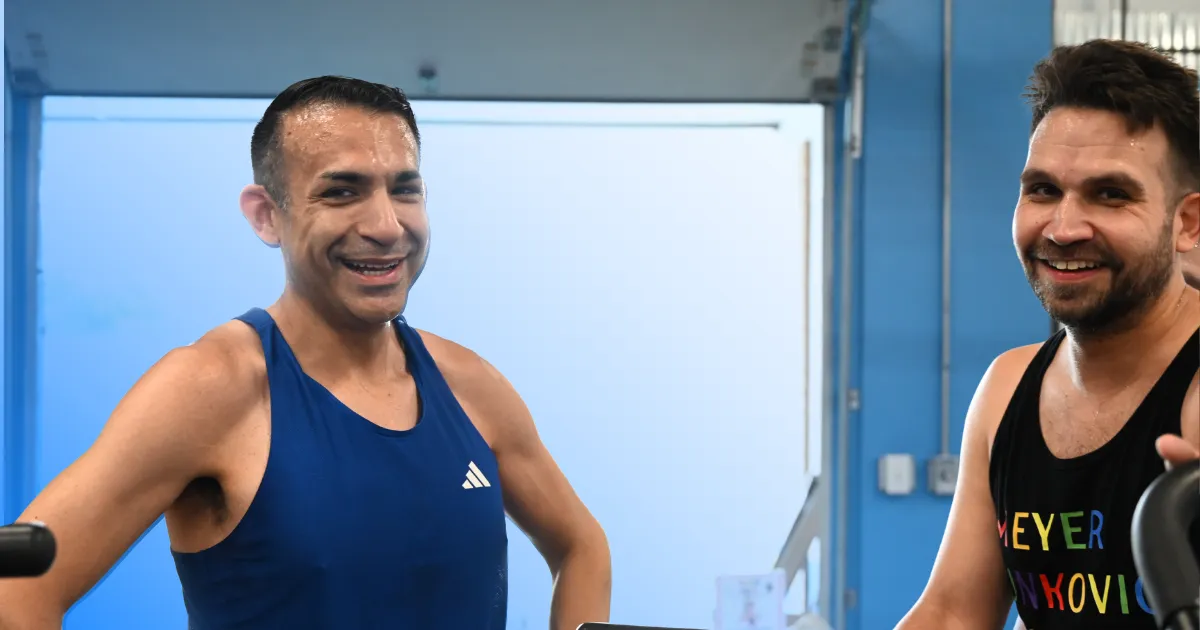
Joel is a 72-year-old ER doctor and has been a member at Pittsburgh FIT for nine years. He came in originally with back pain that was interfering with his life. He and Coach Erika spent a few months focused on core work and movements he could do without pain, and the back pain went away. That was the original goal, and it got solved.
He stayed for a different reason. Joel loves endurance events, and he decided somewhere along the way that how he moves at eighty is being determined right now, by what he does on ordinary Tuesdays.
So he invented his own event. Every year on his birthday, Joel does the same number of burpees as the age he is turning. Last year that meant 71 of them. He and Erika also work on pull-ups, mobility, and general strength, one session a week alongside his classes, fitted around a schedule that changes constantly because he is an ER doctor.
Joel has never done a HYROX. He is not a former athlete. He is a guy with a demanding job who picked a number, put it on the calendar, and trained for it, and has now done that nine years running.
He is also, by wide agreement, the most welcoming person in the building. He comes early to classes and stays late to talk to new members. If we had an ambassador program, that would be settled.
Also fine, and more common than the confident people in the gym would suggest.
Palma came to us at 55 dealing with hip pain that was getting in the way of things she wanted to do, along with some digestive issues she had been navigating for a while. She worked with Coach Vee on training and Coach Heather on nutrition. Five weeks in, she had dropped 3.7% body fat, her muscle mass was up, and the hip pain had stopped.
The part that matters more: she went to California to summit Mt. Whitney, the highest peak in the lower forty eight, at 14,505 feet. At 55. Her own read on it was that mindset is the biggest limiting factor to aging.
We would not put it much differently. The physical constraints at 55 or 72 are real and they are also much smaller than the psychological ones.
Four adjustments, none of them dramatic.
Give yourself more runway. If a thirty year old needs ten weeks to prepare for something, give yourself fourteen or sixteen. The training does not need to be easier. It needs more time to accumulate.
Progress load more slowly than feels necessary. This is the single most common way older athletes get hurt. Muscle adapts faster than tendon, so the weight your muscles can handle in week four may be more than your connective tissue is ready for. Patience here is not caution, it is strategy.
Protect recovery deliberately. Sleep, protein, and spacing hard sessions further apart. A session you recover from is worth more than a session you admire.
Get eyes on your movement. This is where personal training earns its cost after sixty. Not for motivation, but because someone watching your mechanics weekly catches the thing that would have become an injury. Joel's one session a week with Erika is exactly this.
With something small, dated, and coached.
Not a full race. Something local and scaled, close enough to feel real and forgiving enough that a first attempt does not have to go perfectly. Something with coaches on the floor who will adjust the weight, cue the movement, and make sure you finish standing.
That is precisely what we built the Half HYROX for.
Am I too old to do a fitness race like HYROX?
Almost certainly not. HYROX and most similar events have a minimum age of sixteen and no upper limit, with age group divisions running well into the seventies. Open, partner, and relay formats let you enter without meeting any standard. The real constraints are recovery time and injury history, both manageable with coaching.
Can you build muscle and strength after 60?
Yes. Resistance training produces measurable strength and muscle gains in adults starting in their sixties and seventies. The response is slower and smaller than it would be at thirty, but it is real and it shows up in daily function. Progressing load gradually matters more than it did at a younger age.
What is the biggest risk of training for an event later in life?
Adding load faster than your connective tissue can adapt. Muscle strengthens more quickly than tendon does, so the common injury pattern is progressing weight based on how strong you feel rather than how long the tissue has had. Longer training blocks and weekly coaching both reduce this.
How long should an older beginner train before an event?
Give yourself fourteen to sixteen weeks rather than the ten a younger beginner might use. The sessions do not need to be gentler, but the progression needs more time. Starting with a shorter scaled version of the event first is often better than aiming straight at a full race.
Is personal training worth it after 60?
It becomes more valuable, not less. The main return is not motivation but movement quality. A coach watching your mechanics each week catches the small compensations that turn into injuries, and adjusts your progression to your actual recovery rather than a generic template.




.png)


.png)





.webp)
.webp)
.webp)
.webp)





.webp)

.webp)








.webp)


.webp)
.webp)



.webp)
.webp)
.webp)
.webp)
.webp)
.webp)
.webp)
.webp)
.webp)
.webp)
.webp)
.webp)
.webp)
.webp)
.webp)
.webp)
.webp)
.webp)
.webp)
.webp)
.webp)
.webp)
.webp)
.webp)
%2520(1).webp)
.webp)
.webp)
.webp)
.webp)
.webp)
.webp)
.webp)
.webp)
.webp)

.webp)
.webp)
.webp)
.webp)
.webp)
.webp)

.webp)
.webp)
.webp)
.webp)
.webp)