.webp)
Right now your September is still theoretical. In four weeks it will not be, and you will be trying to build a new habit in the middle of the busiest stretch of your year. That is roughly like learning to swim during a storm.
The best time to build a fall fitness plan is early August, while your calendar still has room in it. Build it in four parts: pick an hour nothing else can claim, attach a real appointment with a coach, define a six-month outcome you can actually measure, and start before September rather than after it. Habits built under pressure rarely survive the pressure that built them.
This is the assembly guide for the two ideas in Parts 1 and 2 of this series.
Three to four weeks before your busy season begins, not after it arrives. For most career professionals in Pittsburgh, that means the first two weeks of August.
The logic is simple. A new habit needs roughly three weeks of low-friction repetition before it stops requiring active decision-making. If you start in mid-September, those three weeks land on top of school schedules, Q4 planning, travel, and the general acceleration that hits every year. The habit never gets its quiet stretch, so it stays a decision, and decisions lose to busy weeks.
Start now and the habit is already automatic by the time your calendar closes. Same effort, completely different outcome, purely because of when you spent it.
Four components, and most failed plans are missing at least two of them.
A defensible hour. Not a preference, a slot. Written into the calendar the same way a client call is.
A real appointment with a person. Not a membership, not an app, not an intention. Someone who has your name on their schedule and will notice if you are not there.
A measurable six-month outcome. Not "get in shape." Something you could photograph or write down.
A nutrition floor. One or two habits you can hold on your worst week, not a full overhaul you will abandon by Labor Day.
Notice what is missing from that list. There is nothing about intensity, no specific program name, no supplement, and no six-week challenge. Those things are downstream of structure, and structure is what actually fails.
Ask yourself which hour of your week nobody else currently has a claim on, then be honest about the answer.
For most of the people we coach across Point Breeze, Regent Square, Squirrel Hill, Edgewood, and Wilkinsburg, that hour is before the workday rather than after it. Nobody schedules a 5:45am meeting. No client emails at 6am expecting a response before your session. Evening slots sit downstream of every meeting that runs long and every text that starts with "any chance you could."
That is not a rule, though. Some people genuinely have protected evenings, and for them a 6pm Tuesday is more defensible than a 6am Monday would be. What matters is that the hour survives a bad week, not that it looks disciplined.
Pete, one of our personal training clients, has trained before 5am every session for seven months straight. He started with Coach Erika squatting a 35 pound kettlebell and now squats 215 pounds for reps. His deadlift went from a 53 pound kettlebell to 275 for three. You do not need his hour. You need an hour that behaves like his does.
It looks like someone expecting you at a specific time, with your work already written down before you arrive.
People tend to imagine accountability as motivation delivered by a stranger, which sounds exhausting and slightly embarrassing. In practice it is far more boring than that. Coach Ivan knows what you lifted last Tuesday. He wrote today's session last night based on how the last one went. He will send a message if you go quiet for a week.
That is the whole mechanism, and it works because it converts a promise you made to yourself into an obligation to another person. You have already learned that you will break the first kind quietly at 5:40 in the morning. Almost nobody breaks the second kind.
If you have started over more than twice in the last three years, this is the piece that has been missing, not information. We went deeper on why in Part 2 of this series.
Specific enough that you would know on sight whether it happened.
"Get in shape" cannot be evaluated, which means it cannot be pursued. Replace it with something you could write on a card. Deadlift your bodyweight. Get through a hike in Frick Park without stopping. Finish a 5K without walking. Stop needing the 3pm coffee. Carry all the groceries in one trip without thinking about it.
Six months from early August lands you in February, which is worth noticing. It means you would arrive at the new year already three months into something rather than starting over on January 2nd with everyone else. That is a meaningfully different position to be in.
The members who last four and five years with us almost all had a first goal that sounded small. The size of the goal is not what predicts whether you are still here. The specificity is.
Pick your hour, then get someone to help you build the rest of it around your actual life.
We have personal training openings right now at 6am and 8am on Mondays and Wednesdays, and 6pm on Tuesdays and Thursdays. Some are with Gianfranco, the newest coach on our team. Some are with Ivan, who has been coaching at Pittsburgh FIT for years. Both do the same thing Coach Erika did for Pete: learn your name, your history, your bad knee, and your real schedule, then build the plan around all of it.
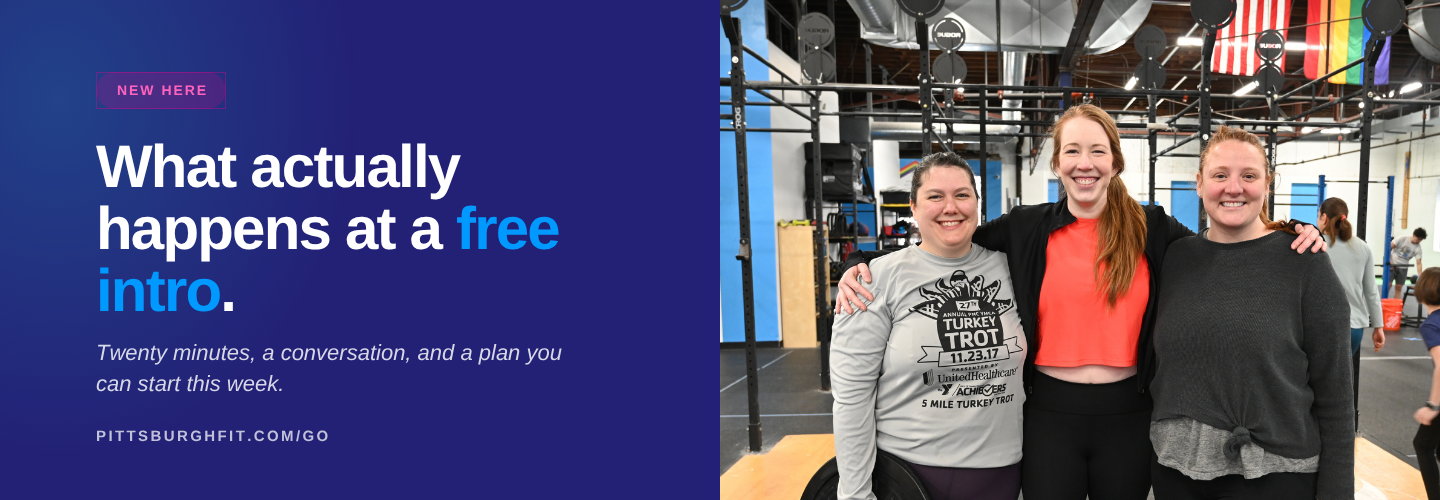
The first step is a free intro. It is 45 minutes at 210 Thomas St, there is no workout, and nobody is going to weigh you in front of anyone. It is a conversation about what you want, what has not worked before, and which of those open slots actually fits your week. If the honest answer at the end is that you do not need coaching, we will tell you that too.
Four weeks from now this gets harder. Not impossible, just harder, and for no reason other than timing.
Book your free intro at Pittsburgh FIT
45 minutes. No workout. No pressure. Just a conversation about what you want and which open slot actually fits your life.
CLICK HERE to Book for Free
Pittsburgh FIT | 210 Thomas St, Pittsburgh PA 15221
When should I start a fitness plan for the fall?Early to mid August is ideal. A new routine needs roughly three weeks of low-friction repetition before it stops requiring active decision-making. Starting in August gives the habit that quiet stretch before school schedules, travel, and end-of-year work arrive and start competing for the same hours.
How do I stay consistent with workouts when work gets busy?Protect an hour that other people cannot claim, usually early morning, and attach it to a fixed appointment with a coach rather than an open membership. Consistency during busy stretches comes from removing the daily decision, not from summoning more discipline on hard days.
How many days a week should I train to stay consistent?Two to three sessions a week is the sweet spot for most busy professionals. It is frequent enough to drive real strength and body composition change, and sparse enough to survive a hard week without collapsing. Four or more works better once the habit is established.
What is a realistic six-month fitness goal?Something specific enough to evaluate on sight. Deadlifting your bodyweight, finishing a 5K without walking, hiking Frick Park without stopping, or carrying groceries in one trip are all better goals than getting in shape, because you can tell whether they happened.
What happens at a free intro at Pittsburgh FIT?It is a 45 minute conversation at 210 Thomas St with no workout involved. A coach asks about your goals, your history, what has not worked before, and your actual schedule, then recommends a starting point. There is no fitness test and no weigh-in.

.png)



.webp)
.webp)
.webp)
.webp)
.webp)





.webp)










.webp)


.webp)
.webp)


.webp)
.webp)
.webp)
.webp)
.webp)
.webp)
.webp)
.webp)
.webp)
.webp)
.webp)


.webp)
.webp)
.webp)
.webp)
.webp)
.webp)
.webp)
.webp)
.webp)
.webp)
.webp)
.webp)
.webp)
%2520(1).webp)
.webp)
.webp)
.webp)
.webp)
.webp)
.webp)
.webp)
.webp)
.webp)


.webp)
.webp)
.webp)
.webp)
.webp)
.webp)

.webp)
.webp)
.webp)
.webp)
.webp)
.webp)
.webp)
.webp)
.webp)
.webp)
.webp)
.webp)