
How Do You Train for HYROX Without Upending Your Life? (Part 2 of this series)

How Do You Train for HYROX Without Upending Your Life? (Part 2 of this series)
How Do You Train for HYROX Without Upending Your Life? (Part 2 of this series)
How Do You Train for HYROX Without Upending Your Life? (Part 2 of this series)
You have probably seen the videos. Somebody shoving a sled across a convention center floor while a crowd yells, or grinding through wall balls with their legs visibly gone. It looks impressive and a little intimidating, and the first question most people have is also the simplest one: what is this, exactly?
HYROX is a fitness race made of eight one-kilometer runs alternating with eight workout stations, always in the same order, anywhere in the world. There is no qualifying standard and no tryout. Anyone sixteen or older can register. Most first-timers finish somewhere between ninety minutes and two hours.
That is the whole thing. Everything else is detail, and the detail is worth knowing before you decide whether this belongs on your calendar.
You run one kilometer. You complete one station. You repeat that eight times. Eight runs, eight stations, same sequence whether you are racing in Pittsburgh, Chicago or Prague.
That consistency is the point of the sport. A marathon course changes with the city. A HYROX race does not. Your time in one city is directly comparable to your time in another, and to your own time last year, which is why it appeals so strongly to people who like a measurable answer to the question "am I actually getting fitter?"
Between each station and the next run there is a transition area called the Roxzone. Your clock keeps running through it. Most first-timers lose more time there than they expect, which is one of the small things that a coach will tell you and a YouTube video usually will not.
No. There is no qualifying time, no invitation, no tryout, and no minimum fitness level you have to hit before they let you register. Anyone sixteen and older can sign up for an open division race. That single fact surprises people more than anything else about the sport.
We bring this up early because it is the most common misconception we hear at Pittsburgh FIT. People assume there is a gate. They assume somebody checks whether you belong there. Nobody does. The only requirement is deciding to start, and then giving yourself enough runway to arrive prepared.
There are three ways into the same race, and none of them is the "real" one.
Individual is the full eight kilometers and all eight stations on your own, at your own pace.
Doubles is two people sharing the whole thing. You split the eight kilometers of running and all eight stations however you want, and you move through the race side by side. If one of you is having a rough patch, the other one absorbs a little more of the work.
Relay is four people. Each teammate runs two kilometers and completes two stations. The last teammate takes on the wall balls while the other three wait at the rig, and then all four cross the finish line together.
If you are reading this and quietly hoping somebody will tell you that doubles counts, it counts. Doubles and relay are not the beginner versions of a real race. They are three different doors into the same room, and which one you walk through first is entirely your call.
Here they are in order, with the standard that actually gets people no-repped and how our coaches train each one.
1. SkiErg, 1,000 meters. A rower-style machine you pull down rather than push, working arms, lats and core. Both feet stay on the platform for the full thousand meters. Heels can hang over the edge but cannot touch the floor. Our coaching note: go conservative here. It is the first station, everyone feels great, and most first-timers burn energy they badly need at minute eighty.
2. Sled Push, 50 meters. A weighted sled pushed across the floor in four lengths of 12.5 meters. You and the sled start fully behind the line, and the sled has to completely cross each mark before you turn. This is a legs-and-core station, not an arms station. Low shin angle, short driving steps.
3. Sled Pull, 50 meters. Hand over hand on a rope, pulling the sled toward you, standing the entire time. No pulling from a seated or kneeling position, and you stay inside the marked box at each end. This one catches people off guard because it is a grip and upper back event, and grip is the thing nobody trains on purpose.
4. Burpee Broad Jump, 80 meters. A burpee, then a broad jump, repeated down the length of the section. Your chest makes clear contact with the ground on every rep and your feet land together on the jump. No shuffling. We call this the mental station, because most people talk themselves out of it well before their body actually quits.
5. Rowing, 1,000 meters. A seated row on the erg, and far more tiring at this point in the race than it is fresh. You sit with your feet on the footplates before touching the handle, and they stay there for the full thousand. Technique is worth real minutes here. One of our clients, Andrea S., dropped her 500-meter row from 2:02 to 1:54 in a single training cycle just by having a coach watch her form every week.
6. Farmers Carry, 200 meters. Two weighted kettlebells at your sides, sometimes several laps depending on the venue. Both bells travel at once with arms extended. You can set them down to rest, but they cannot move forward while resting, and they return to the box handles-up. Grip gives out here long before legs or lungs do.
7. Sandbag Lunges, 100 meters. Walking lunges with a weighted sandbag across both shoulders. You load the bag yourself, it stays on both shoulders the whole way, and your trailing knee clearly touches the ground every rep. This is the station that quietly ends races. Tired legs plus a loaded bag does not forgive sloppy mechanics.
8. Wall Balls, 100 reps. Squat below parallel, throw the ball to a target, one hundred times, to close out the day. Your hip crease drops clearly below your knee and the ball hits the target. There are no warnings on this station. It is a rep or it is not.
Notice how many of those come down to grip, hinging and lunging under fatigue. That is not a coincidence, and it is the entire argument for training the movements weekly instead of cramming them.
Most first-timers finish between ninety minutes and two hours. Elite athletes go considerably faster, and plenty of people go considerably slower, and both of those facts are irrelevant to your day.
Please do not compare yourself to the leaderboard. Compare yourself to the person who has not started yet. That is the only comparison that has ever improved anybody's life.
You probably will not be. And if you are, on that day, in that moment, nobody around you is watching your pace. They are watching their own.
Every person in that Roxzone remembers their first race and exactly what it cost them to show up. That is the real culture of this sport, and it is the culture we build in our classes in Pittsburgh's East End long before race day arrives. We have written a whole post on this fear, because it is the single most common reason people never register.
You do not need a HYROX-specific membership or a garage full of sleds to train for this. Our Tuesday, Thursday and weekend group fitness classes at Pittsburgh FIT were built around exactly these patterns: strength, conditioning, and the specific movements the race demands, coached in real time on the real equipment.
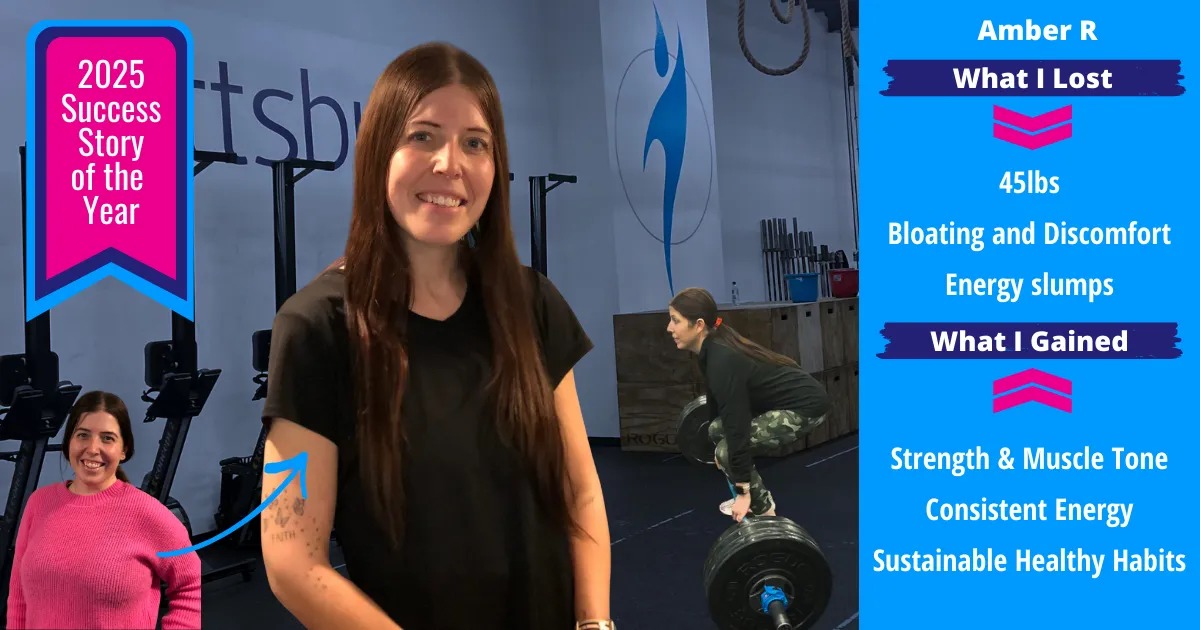
Take Amber R., a 34-year-old OR nurse who joined us wanting to get ahead of a family history of preventable disease. She trained with Coach Corey in personal training twice a week, worked with Coach Heather on nutrition, and added our Tuesday classes as her Half HYROX approached. She lost 17 pounds in three months and finished her Half HYROX in 58 minutes without walking a single one of her 500-meter runs. She was not a former college athlete. She was somebody who started.
Here is the part we will say out loud, because founder and lead coach Jodi Butler has been saying it for the twelve years Pittsburgh FIT has been open: the race is not the point. HYROX is having a moment, and so did Spartan Races and marathons and everything before them. What lasts is the base underneath. Squat, hinge, carry, push, pull, and enough aerobic capacity to keep going. That base is what gets you up your own front steps at seventy five, and a race is just a dated, motivating reason to build it.
Next in this series: how to actually train for HYROX without upending your life, including the weekly structure we recommend and how many weeks you really need.
Want all of this in one place? Our free HYROX Starter Guide walks through every station, the training plan, and how to tell if now is your moment. Grab it at PittsburghFIT.com/Go.
What is HYROX in simple terms?HYROX is a fitness race combining eight one-kilometer runs with eight workout stations, completed in a fixed order. The stations are SkiErg, sled push, sled pull, burpee broad jumps, rowing, farmers carry, sandbag lunges and wall balls. Most first-timers finish in ninety minutes to two hours.
Do you need to qualify to enter a HYROX race?No. HYROX has no qualifying standard, tryout or invitation requirement. Anyone aged sixteen or older can register for an open division race. The only real requirement is giving yourself enough training runway, typically ten to sixteen weeks, so you arrive prepared rather than hoping for the best.
What is the difference between HYROX individual, doubles and relay?Individual means completing all eight kilometers and eight stations alone. Doubles means two people splitting the running and stations however they choose. Relay means four people, each covering two runs and two stations. None is considered lesser. They are three legitimate formats of the same race.
How many wall balls are in a HYROX race?The final station is one hundred wall balls, performed after eight kilometers of running and seven previous stations. Every rep requires the hip crease to drop clearly below the knee and the ball to strike the target. There are no warnings, so technique under fatigue matters enormously.
Can a beginner do HYROX?Yes, with adequate preparation. Most sources converge on ten to sixteen weeks of training depending on your starting point. Beginners often choose doubles or relay for their first race. Training with coaches who watch your form weekly meaningfully improves both your finish and your injury risk.

.webp)
.webp)
.webp)
.webp)
.webp)





.webp)

.webp)








.webp)


.webp)
.webp)



.webp)
.webp)
.webp)
.webp)
.webp)
.webp)
.webp)
.webp)
.webp)
.webp)
.webp)


.webp)
.webp)
.webp)
.webp)
.webp)
.webp)
.webp)
.webp)
.webp)
.webp)
.webp)
.webp)
.webp)
%2520(1).webp)
.webp)
.webp)
.webp)
.webp)
.webp)
.webp)
.webp)
.webp)
.webp)

.webp)
.webp)
.webp)
.webp)
.webp)
.webp)

.webp)
.webp)
.webp)
.webp)
.webp)
.webp)
.webp)
.webp)
.webp)
.webp)
.webp)
.webp)
.webp)
.webp)
.webp)
.webp)