You know you need a plan for the winter. The problem is that most winter plans are built for the person you are in September, not the person you'll be on a dark Tuesday in December with a full inbox and three holiday events on the calendar.
A realistic winter workout schedule for most busy professionals is two to three strength sessions a week at fixed times, plus short walks on other days. Put your sessions where your energy is most reliable, often mornings or lunch once it gets dark early, and plan a lighter holiday version ahead of time so a busy week bends your plan instead of breaking it.
This is Part 3 of our winter series. Part 1 covered the one decision to make before the clocks fall back, and Part 2 explained why winter drains your energy. Now let's turn it into a schedule you can actually follow.
Two to three strength sessions a week is the sweet spot for most busy adults. Two is a real program, not a consolation prize. It's enough to hold onto your strength, keep building, and keep the habit alive through the darkest months.
Three is great if your schedule allows it. Four or more usually isn't necessary in winter, and it often backfires when sleep is shorter and calendars are fuller. The goal right now isn't to set records. It's to arrive in January still going.
Pick two days with at least one rest day between them, and train at the same time each week. Tuesday and Thursday works well for a lot of people. So does Monday and Thursday, which leaves Friday free for the inevitable end-of-week chaos.
Each session should be full-body strength work: a squat or lunge, a hinge like a deadlift, a push, a pull, and something you carry. That covers the big muscle groups and keeps your sessions efficient, which matters when you only have an hour.
On two or three other days, add a 15 to 20 minute walk, ideally at lunch when you can catch some daylight. If you work in the East End, our guide to lunch-break walks near Regent Square, Point Breeze, and Frick Park has plenty of options. This two-day plan is perfect for the busiest professionals, new parents, people who travel a lot, and anyone getting back into training after a break.
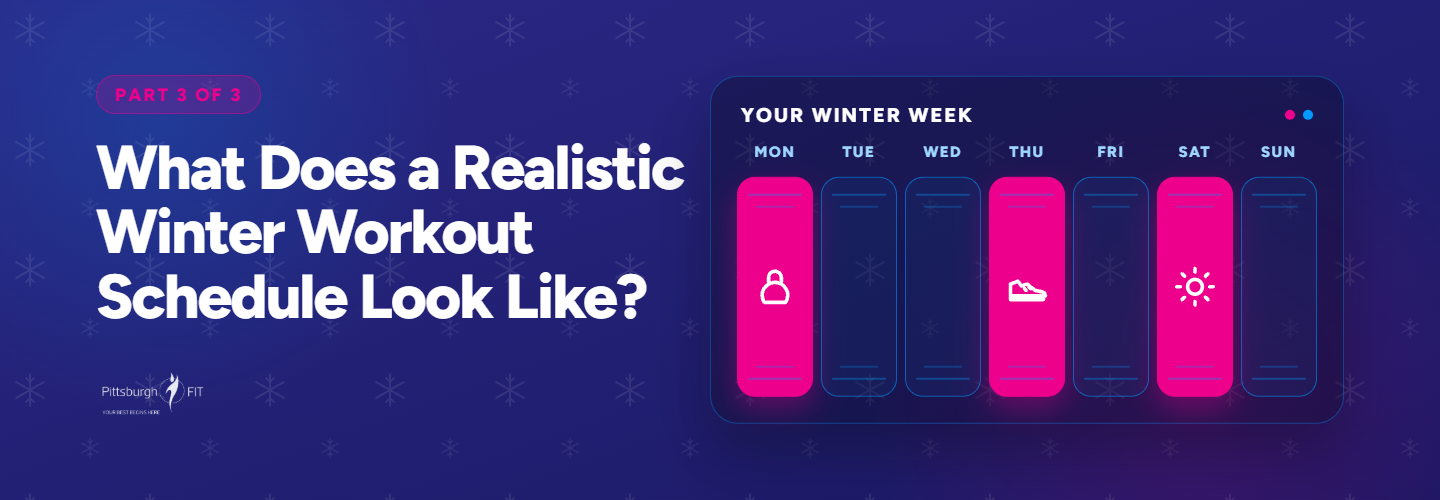
Three sessions spread across the week, with one of them on the weekend. Monday, Wednesday, and Saturday is a great winter rhythm. So is Tuesday, Thursday, and Saturday.
The weekend session is the secret weapon here. A Saturday morning workout happens in daylight, it isn't competing with work, and it gives you a strong start to the weekend. If one of your weekday sessions gets knocked out by a late meeting, you've still got two in the bank.
Keep your weekday sessions full-body like the two-day plan, and use the weekend session for whatever you enjoy most, whether that's a group class, a longer strength session, or something with friends.
The best time is the one you can repeat. That said, mornings have some real advantages once it gets dark early.
Morning sessions are less likely to get bumped by meetings that run long, and they get your training done before the early-evening energy slump hits. They also pair nicely with getting outside in the morning light, which helps your internal clock in the winter. Lunchtime sessions or walks work for similar reasons.
Evenings can absolutely work too, especially if your mornings are already full. Just protect them like appointments, go straight from work, and if your sleep is fragile, try to finish hard training two to three hours before bed so your body has time to wind down.
Plan a holiday version of your schedule now, before you need it. Your holiday version is the smallest plan that still counts, like one strength session and a couple of walks a week.
Look at your calendar for late November and December and mark the weeks that are already packed with travel, family, or year-end deadlines. Those are your holiday-version weeks. Everything else stays normal. Making this call in advance means a busy week becomes a planned lighter week, not a sign that you've fallen off.
If you're traveling, a 20-minute bodyweight session in a hotel room or a long walk around a new city counts. And when the holidays are over, go right back to your regular schedule. No making up for anything and no starting over. Just your next session.
Because your sessions become appointments with a person, not promises to yourself. It's surprisingly easy to skip a workout you planned alone on a cold, dark evening. It's much harder to skip when a coach has your session written and is expecting you.
A good coach also adjusts with you. When a week falls apart, Coach Jodi Butler and the team at Pittsburgh FIT would rather move your session or shorten it than watch you disappear for a month. They know what winter does to people's energy, and they plan for it instead of pretending it isn't coming.
That's the real difference. A winter plan that survives isn't the most impressive plan. It's the one built around your actual life, with someone helping you keep it.
Want a winter plan built around your real schedule?
Book a free intro at Pittsburgh FIT. It's a 45-minute conversation with a coach at 210 Thomas St about your goals, your history, and your actual week. No workout, no weigh-in, and no pressure.
Book your free intro: PittsburghFIT.com/Go
Curious what actually happens when you book? Here's what to expect at a free intro. And if you're feeling a little less steady on your feet as icy sidewalks approach, read How Do You Improve Your Balance After 40?
What is a good workout schedule for winter?
For most busy adults, two to three full-body strength sessions a week at fixed times works best, plus short walks on other days. Schedule sessions when your energy is most reliable, often mornings or lunch once it gets dark early, and plan a lighter holiday version ahead of time for your busiest weeks.
Is working out twice a week enough?
Yes. Two full-body strength sessions a week is enough to maintain and build strength, especially when you're consistent. It's a legitimate program, not a minimum. For busy professionals, two sessions you actually complete every week will beat a four-day plan that falls apart by the holidays.
How do I stay consistent with workouts during the holidays?
Decide on a holiday version of your schedule before the season starts, such as one strength session and a couple of walks a week. Mark your busiest weeks in advance, use the lighter plan for those, and return to your normal schedule right after without trying to make up for missed sessions.
Should I work out in the morning or at night in winter?
Whichever you can repeat consistently. Mornings tend to work well in winter because they avoid early-evening energy slumps and are less likely to get bumped by meetings. If evenings fit your life better, protect them like appointments and try to finish hard training two to three hours before bed.