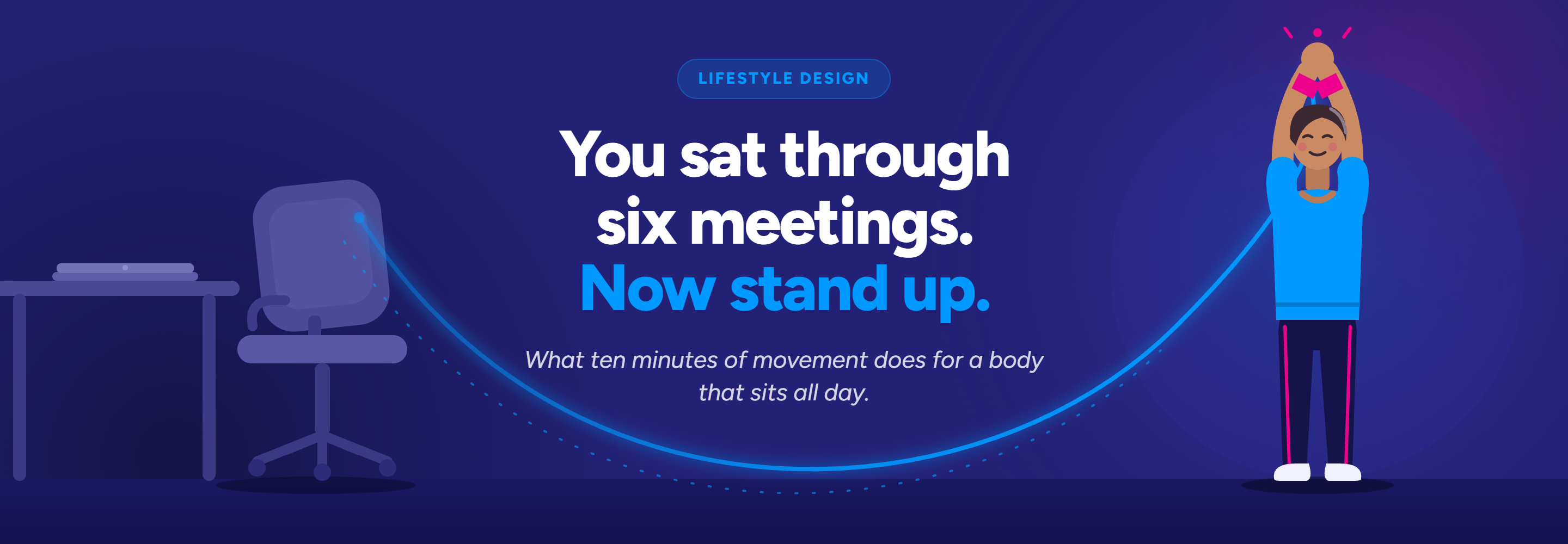
You stand up after a three-hour block of calls and your body takes a second to catch up. Your hips feel like rusty hinges, your lower back has an opinion, and your shoulders have drifted somewhere toward the screen. You're not old. You've just been sitting.
Sitting all day makes your hips and back stiff because your body adapts to the positions it holds most. Hours in a chair keep your hip flexors shortened, leave your glutes underused, and let your upper back round forward. Short movement breaks and strength training that works in the opposite direction ease that stiffness better than stretching alone.
Here's what is actually going on, and what we do about it with the desk-heavy professionals who train with us in Pittsburgh's East End.
It makes your body very good at sitting, and a little worse at everything else. That isn't damage. It's adaptation, which is the same process that makes you stronger when you train.
Add up a typical day for most of the people we coach: the drive in, the desk, lunch at the desk, the drive home, dinner, the couch. That can easily be ten or eleven hours in a seated position. Your muscles, joints, and nervous system respond to whatever you do most, and for many of us, that is sitting with our hips bent, our glutes switched off, and our head and shoulders leaning toward a screen.
None of that is broken. It's just practiced. And the good news about anything practiced is that you can practice something else.
Because the front of your hips spends the whole day in a shortened position while the muscles on the back side barely work. When you stand up, the front feels stuck and the muscles that should open your hip are slow to show up.
That combination is why the first squat or lunge after a long workday can feel like starting a car in January. Here's the part most people don't expect: "tight" doesn't always mean short. A lot of the time, tightness is your nervous system putting on the brakes in a position where you don't have much strength. Your body limits range it doesn't trust.
That changes the fix. If tightness is partly a strength problem, then building strength in that range is part of the answer, not just pulling on the muscle harder.
For most people, everyday lower back achiness after sitting comes from holding one position too long, not from an injury. When your hips and glutes aren't doing their share, your lower back tends to pick up the slack.
A slumped seated posture also loads the same tissues in the same way for hours at a time. They get cranky, the way your feet would if you stood in one spot all day. Usually the relief comes quickly once you move, which is a pretty good clue that movement is part of the solution.
One honest note before we go further. If your pain is sharp, shoots down a leg, comes with numbness or tingling, or keeps getting worse, talk to your doctor or a physical therapist first. Everyday stiffness is a different story, and it responds really well to moving more and getting stronger.
Stretching usually helps you feel better for a while, but on its own it rarely changes how stiff you feel the next afternoon. The reason is simple math: five minutes of stretching is up against nine hours of sitting.
If you enjoy stretching, keep it. It feels good, it's a nice way to downshift, and it isn't hurting anything. Just don't expect it to carry the whole load. What actually changes how your body feels day to day is breaking up the sitting itself and building strength through the positions that feel tight. Strength gives your body permission to use range it already has.
A good starting target is once every 30 to 60 minutes, for two or three minutes at a time. You don't need a workout. You just need to interrupt the sitting.
Research on long, uninterrupted sitting points to the breaks themselves being useful, separately from whatever exercise you do before or after work. That's good news, because breaks are easy to fit into a real day. Stand up for phone calls. Walk to refill your water. Do a handful of sit-to-stands from your chair. Reach both arms overhead and lean side to side. Set your meetings to end five minutes early and use that gap to move.
If you want a specific routine to follow, we laid out a full two-minute desk reset in What Are the Best Exercises for People Who Sit All Day?. And if you can get outside, a short walk at lunch is even better. We put together a guide to lunch-break walks around Pittsburgh's East End for exactly that.
Training that does the opposite of sitting: opening and extending the hips, strengthening the glutes, and pulling the shoulders back. In practice, that means hinges, hip extension, rows, and carries.
Hinge movements like kettlebell and Romanian deadlifts teach your hips to do the work instead of your lower back. Glute bridges and hip thrusts train the exact muscles a chair puts to sleep. Rows and other pulling movements build the upper back strength that keeps your shoulders from drifting forward. Carrying something heavy and walking tall ties it all together.
Maurice Rickard is a good example of how this plays out. He's 58, he works in code, and most of his workday is spent sitting at a desk. He originally came to Pittsburgh FIT just to get his body some movement. He has trained with Coach Corey Henning twice a week for more than two years, and his deadlift has gone from 75 pounds to 215. Movement is still a priority for him, but strength became the focus along the way.
Notice what Maurice didn't do. He didn't quit his job, buy a treadmill desk, or overhaul his life. He kept the desk and added two sessions a week of training that pulls in the other direction.
Most people notice a difference within a few weeks of breaking up their sitting and strength training two or three times a week. The day-to-day feel usually improves before the numbers on the bar do.
Getting up off the floor gets easier. The first squat of the day stops feeling like a negotiation. The 4 PM stiffness shows up later, or not at all. Those are small wins, and they're the ones people notice first. If you want to know what those early weeks look like inside a coached gym, we walked through the first month of coached training step by step.
No. You can start today by standing up more often, and that alone will help. A coach becomes useful when you want to train harder without your lower back doing all the work.
The things that matter most for desk-heavy bodies are also the hardest to see in yourself: whether your hips or your back are driving a hinge, whether one side is working harder than the other, and where your starting weights should be. At Pittsburgh FIT, our coaches watch exactly that in the first few sessions with someone new, at 210 Thomas St in the East End, so the training fits the body you actually have after a full workday.
Whatever you do next, pick an hour you can actually protect. We wrote about building a plan that survives a busy season, and the same rules apply here. And if you want to feel this in person, our free Balance Clinic on Saturday, October 31 is open to members and non-members alike. Save your spot at pittsburghfit.com/go.
Can sitting all day cause hip pain?
Long hours of sitting can contribute to hip stiffness and discomfort, because the front of the hip stays shortened while the glutes do very little. Most everyday hip tightness eases with regular movement breaks and strength training. Sharp, worsening, or radiating pain should be checked by a doctor or physical therapist first.
Is a standing desk better than sitting all day?
A standing desk helps mostly because it adds variety, not because standing is better than sitting. Standing still for eight hours brings its own aches. The best setup is the one that keeps you changing positions, so alternate between sitting and standing and take short walking breaks every 30 to 60 minutes.
What is the best stretch for tight hips from sitting?
A half-kneeling hip flexor stretch is a good choice. Kneel on one knee, squeeze the glute on that side, and shift your hips slightly forward until you feel the front of the hip open. Hold for 30 to 60 seconds per side, and pair it with glute and hip strengthening for lasting results.
How many days a week should desk workers strength train?
Two or three sessions a week is plenty for most busy professionals. Focus each session on hinges, hip extension, rows, and carries, which work in the opposite direction of sitting. Consistency over months matters far more than frequency, so pick a schedule you can actually keep during a hard work week.

.png)

.webp)
.webp)
.webp)
.webp)
.webp)





.webp)

.webp)








.webp)


.webp)
.webp)



.webp)
.webp)
.webp)
.webp)
.webp)
.webp)
.webp)
.webp)
.webp)
.webp)
.webp)

.webp)
.webp)
.webp)
.webp)
.webp)
.webp)
.webp)
.webp)
.webp)
.webp)
.webp)
.webp)
.webp)
%2520(1).webp)
.webp)
.webp)
.webp)
.webp)
.webp)
.webp)
.webp)
.webp)
.webp)
.webp)
.webp)
.webp)
.webp)
.webp)
.webp)

.webp)
.webp)
.webp)
.webp)
.webp)
.webp)
.webp)
.webp)
.webp)