.webp)
You have been training for a while now. Maybe a year, maybe five. You show up most weeks, you feel better than you did, and somewhere along the way the progress got quiet. Not gone, just quiet. The weights look about the same as they did last spring. You are not injured, not burnt out, not unhappy. You are just coasting a little, and you know it.
This is the point where most people start shopping for a new program. Often the thing they actually need is a date on the calendar.
Let's name the real objection, because it isn't logistics.
It's that you might be bad at it in front of people. Somebody will read your score off a whiteboard. A twenty-six year old will pass you on the sled. You'll be the slowest person in your heat and everyone will see. For a high-performing adult who is competent at almost everything else in their life, that is a genuinely unpleasant thought.
That fear is reasonable and it's also the point. You spend your workweek in rooms where you are supposed to know what you're doing. There's real value in an hour where you are allowed to be a beginner and nobody's career depends on the outcome.
It gives your training a shape. Open-ended fitness has no natural stopping point, which means it also has no natural sharpening point. When there's an event eight or twelve weeks out, your training suddenly has a reason to be organized. Your coach can build backward from a known date. You have a reason to care about your weak side, your engine, your grip, whatever has been quietly holding you back.
It exposes what you've been avoiding. Everybody has a movement they skip. It usually hides in plain sight for years. The moment that movement shows up on a scorecard, it stops being optional and starts being interesting. Most people find that once they're actually forced to train the thing they've been dodging, it improves fast, because it has never had honest attention before.
It compresses the timeline. Nothing accelerates a habit like knowing you'll be tested. Sessions get harder to skip. Sleep gets more attention. Protein gets more attention. Not because anyone is yelling at you, but because you have something specific you're pointed at.
Here's the part people don't expect.
[CONFIRM: is Grace Dickinson still on staff, and do we want to keep her byline and first-person account? If not, this section can be cut cleanly or replaced with a member story you supply.]
One of our coaches signed up for her first competition about eighteen months into training, mostly because a few persistent people kept asking. She didn't like eyes on her. Her division had thirteen people in it, including her own sister, which added a layer nobody needed. The first workout was pull-ups, push-ups, and air squats, and she could not do a pull-up. She spent the week before privately deciding she would never do this again.
The clock counted down, the nerves left, and with the crowd going she jumped up and got her first pull-up. Then she got another one. She finished the eleven-minute workout with one round and one rep, dead last in her heat, and it's still the performance she's proudest of.
That's the thing about a scorecard. It ranks you against the room, but the number that matters is the one you couldn't do in the parking lot an hour earlier. Everybody in that building is running their own private experiment. The person who wins your division is doing the same thing you are, just further along.
If your picture of fitness competition is barbells and a whiteboard, that picture is a decade old. What's available to a working adult now looks different.
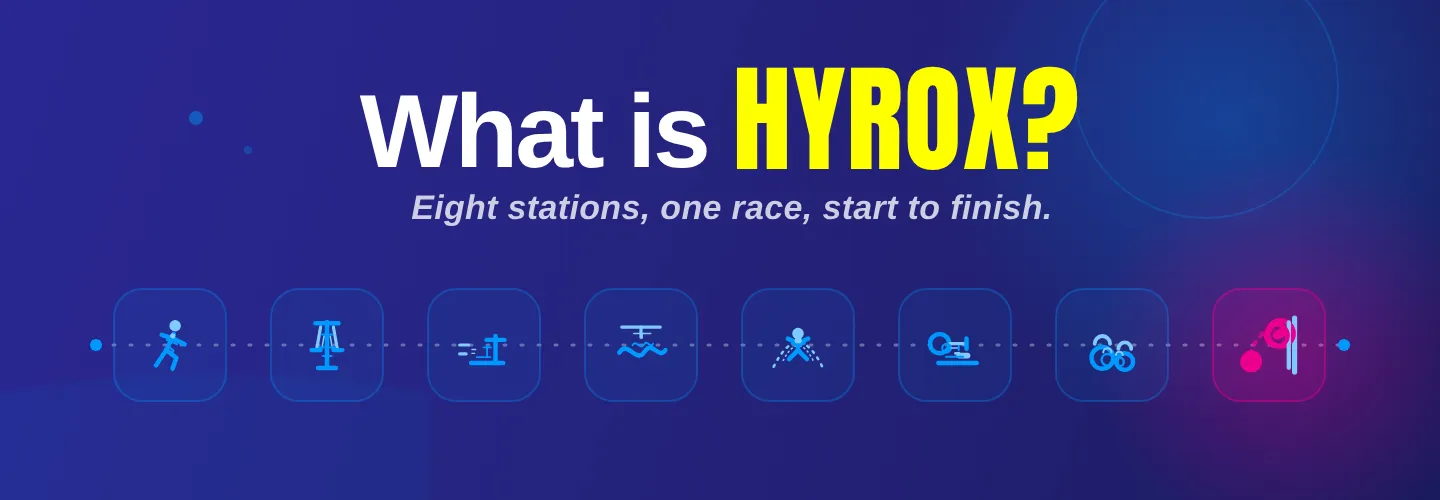
HYROX is the clearest on-ramp. It's the same eight stations in the same order at every event worldwide, which means it's a fitness test rather than a skill test. There are no complicated barbell movements to learn under pressure. You run, you push a sled, you carry things, you row. If you can jog and you're willing to train for a couple of months, you can finish one. The partner format splits the work between two people, which takes a lot of the intimidation out of a first attempt.
Beyond that there are local powerlifting meets, charity throwdowns, and in-house events where the whole point is the room, not the ranking. [CONFIRM: which in-house events are on the calendar for the rest of 2026?]
Pick something eight to twelve weeks out. Close enough to feel real, far enough that you can actually prepare. Pick a format where you already understand the movements, because a first event is not the place to learn a new skill. And if it's an option, do it with a partner or on a team. Having somebody counting on you is worth more than any amount of self-discipline.
Don't overhaul anything. Adults get hurt in the last four weeks before an event more often than they get hurt during it, almost always because they suddenly doubled their training volume out of nerves.
Keep your normal schedule. Add specificity, not quantity. If there's running, run. If there's a sled, push a sled. Practice the transitions, because the gap between stations is where most first-timers lose the plot. And treat the last week as a taper. You cannot build fitness in seven days, but you can absolutely arrive tired.
Then you finish last, and you will have a much clearer picture of what to work on than anyone who stayed home. That's not a consolation prize. That's the actual return on the whole thing.
You'll also find out something more useful: that the fear was heavier than the event. Most people describe the ten minutes before their first heat as far worse than anything that happened after the countdown. Once you know that about yourself, it tends to travel. It shows up in how you handle the next hard conversation at work, the next thing you've been putting off.
You don't need to be ready. You need a date, a plan, and about eight weeks.
If HYROX is the one you're curious about, our HYROX Starter Guide walks through what the eight stations actually involve and how to train for them without rearranging your life. Grab it at PittsburghFIT.com/Go.

.webp)
.webp)
.webp)
.webp)
.webp)





.webp)

.webp)







.webp)


.webp)
.webp)


.webp)
.webp)
.webp)
.webp)
.webp)
.webp)
.webp)
.webp)
.webp)
.webp)
.webp)
.webp)
.webp)
.webp)
.webp)
.webp)
.webp)
.webp)
.webp)
.webp)
.webp)
.webp)
.webp)
.webp)
%2520(1).webp)
.webp)
.webp)
.webp)
.webp)
.webp)
.webp)
.webp)
.webp)
.webp)
.webp)
.webp)
.webp)
.webp)
.webp)
.webp)

.webp)
.webp)
.webp)
.webp)
.webp)
.webp)
.webp)
.webp)
.webp)
.webp)
.webp)
.webp)
.webp)
.webp)
.webp)